Hostinger Canceled My Domain Over Three Letters: What Happens When AI Runs Without Human Judgment

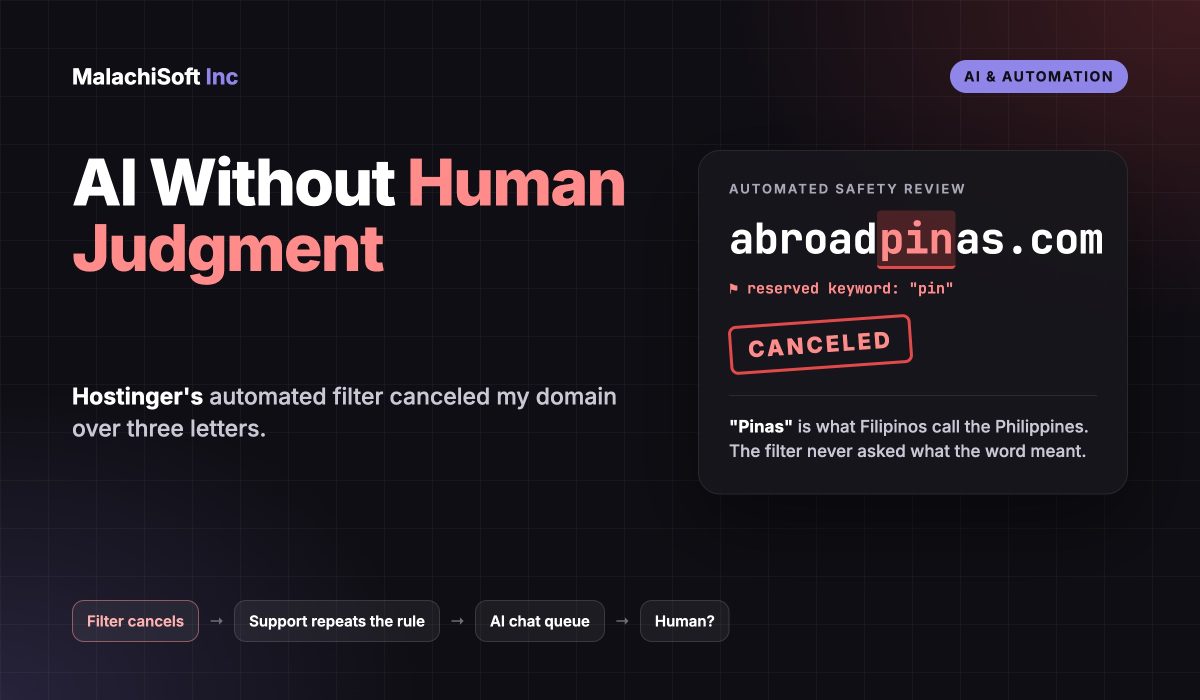
Hostinger‘s automated filter canceled my domain because it contained the letters “pin”. Email support replied within a minute each time (very likely AI as well), admitted the explanation was wrong, and sent me to a live chat where yet another AI stood between me and a person. Here’s what happened, and what every business using AI should learn from it.
I use AI every day, and I love it. Our team at MalachiSoft builds with it, writes with it and ships products faster because of it. So this isn’t a post against AI.
It’s a post about what happens when a company lets automation make a serious decision about a paying customer, and then puts another AI between that customer and a human who can fix it. That’s not using AI well. That’s using AI to skip the part where you care.
What Happened
On October 31, 2026, I registered abroadpinas.com with Hostinger for ₱694.66. I’ve been a Hostinger customer for about five years and have registered many domains with them. This had never happened before.
At 2:12 AM the next morning, this email arrived:
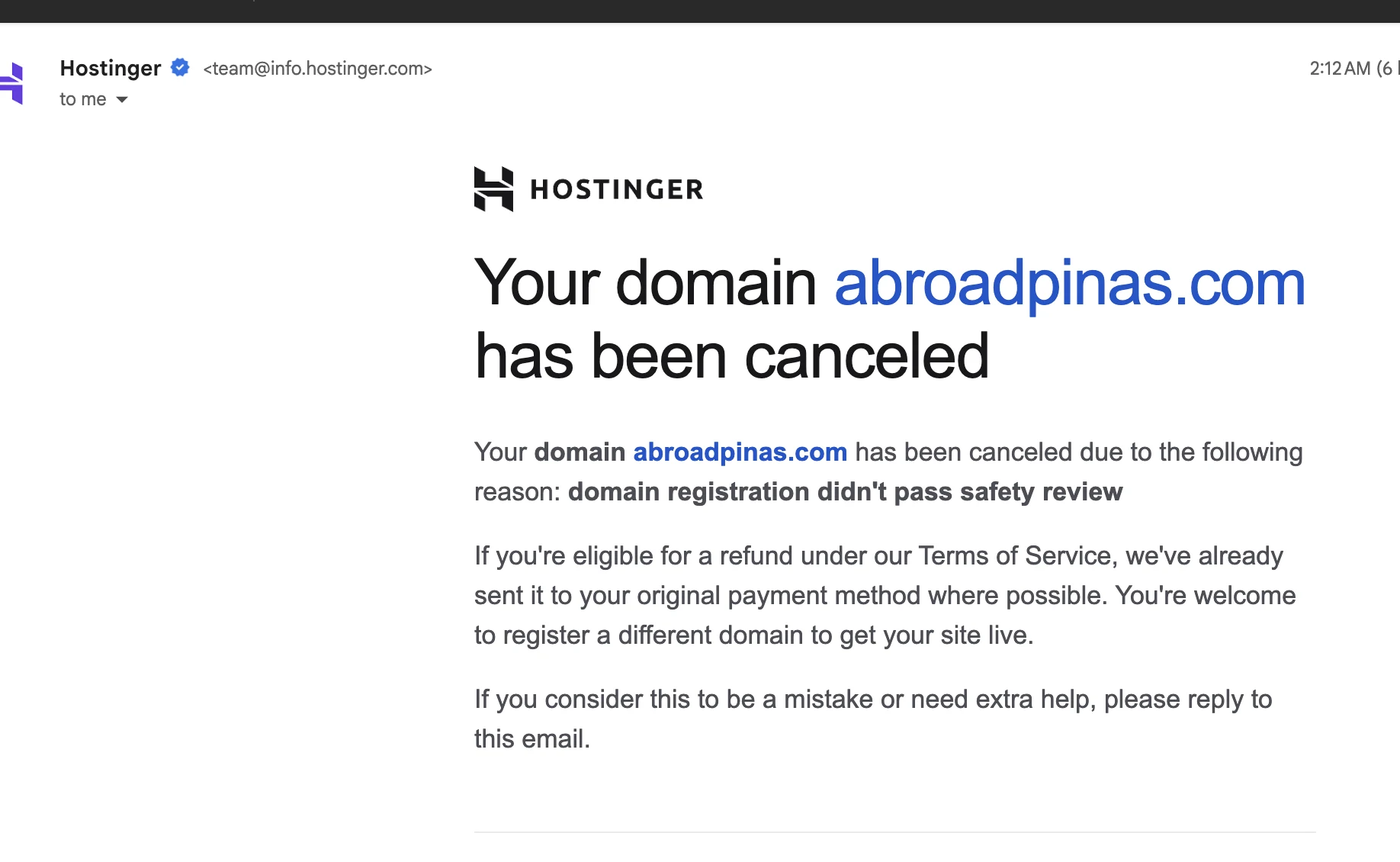
My domain was canceled because it “didn’t pass safety review.” There was no detail about what was unsafe. The email added that a refund had been sent “if you’re eligible” and “where possible.”
The first explanation: a “reserved keyword”
I replied asking what the issue was, and mentioned that the refund hadn’t arrived. The answer came one minute later:
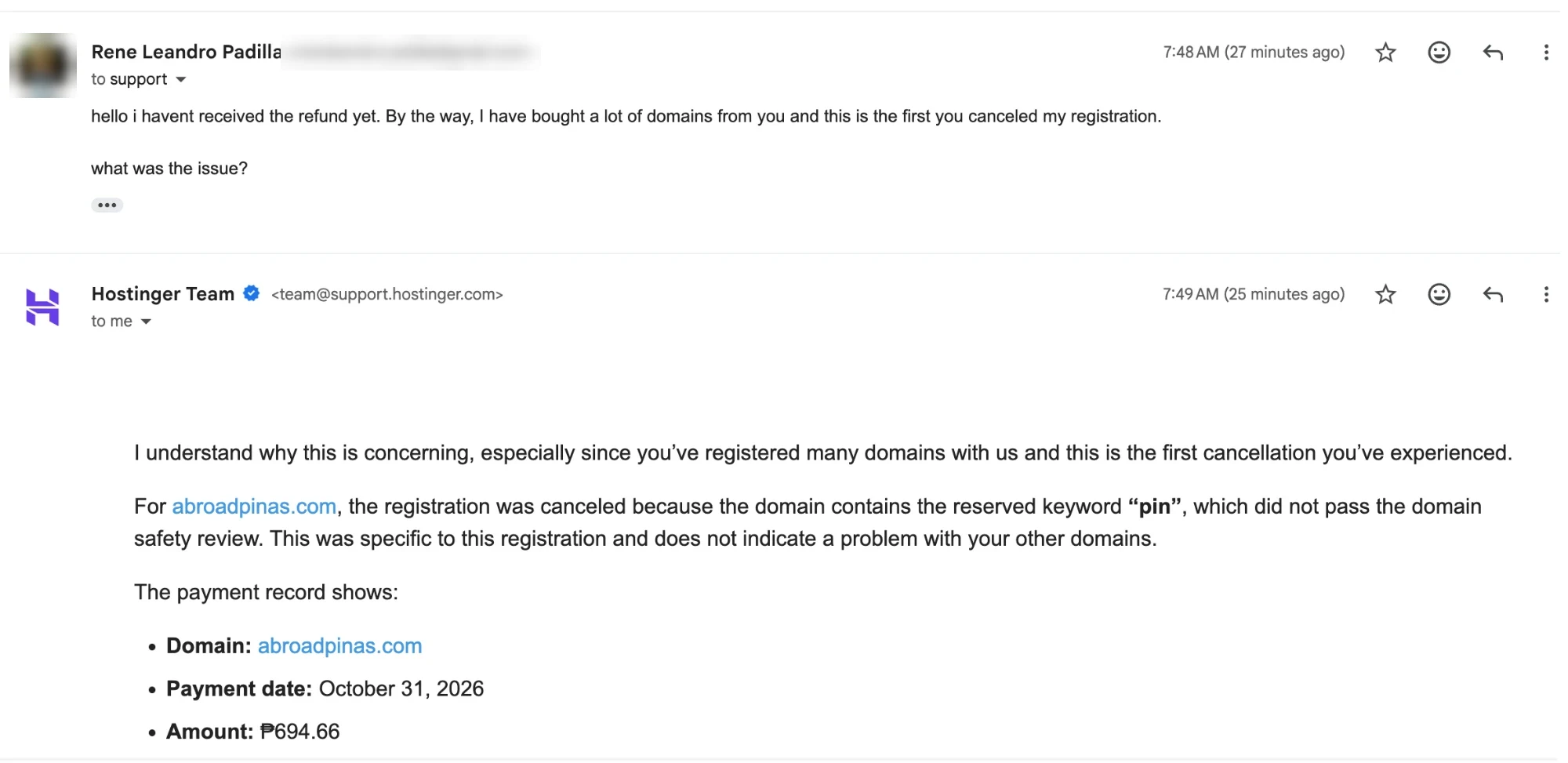
The domain was canceled because it contains the reserved keyword “pin”.
Look at the domain again: abroadpinas.com. The filter found the letters p-i-n inside the word “Pinas” and stopped there.
Why “Pinas” matters
For anyone outside the Philippines: “Pinas” is what Filipinos call the Philippines. It’s an everyday word, used in news headlines, songs, brand names and conversation. Abroad Pinas simply means “abroad, Philippines”, a natural name for a site about Filipinos living overseas.
No person who understood the word would flag it. But no person looked.
The admission
I explained what “Pinas” means and said the safety review was too shallow. The next reply, again within a minute, agreed:
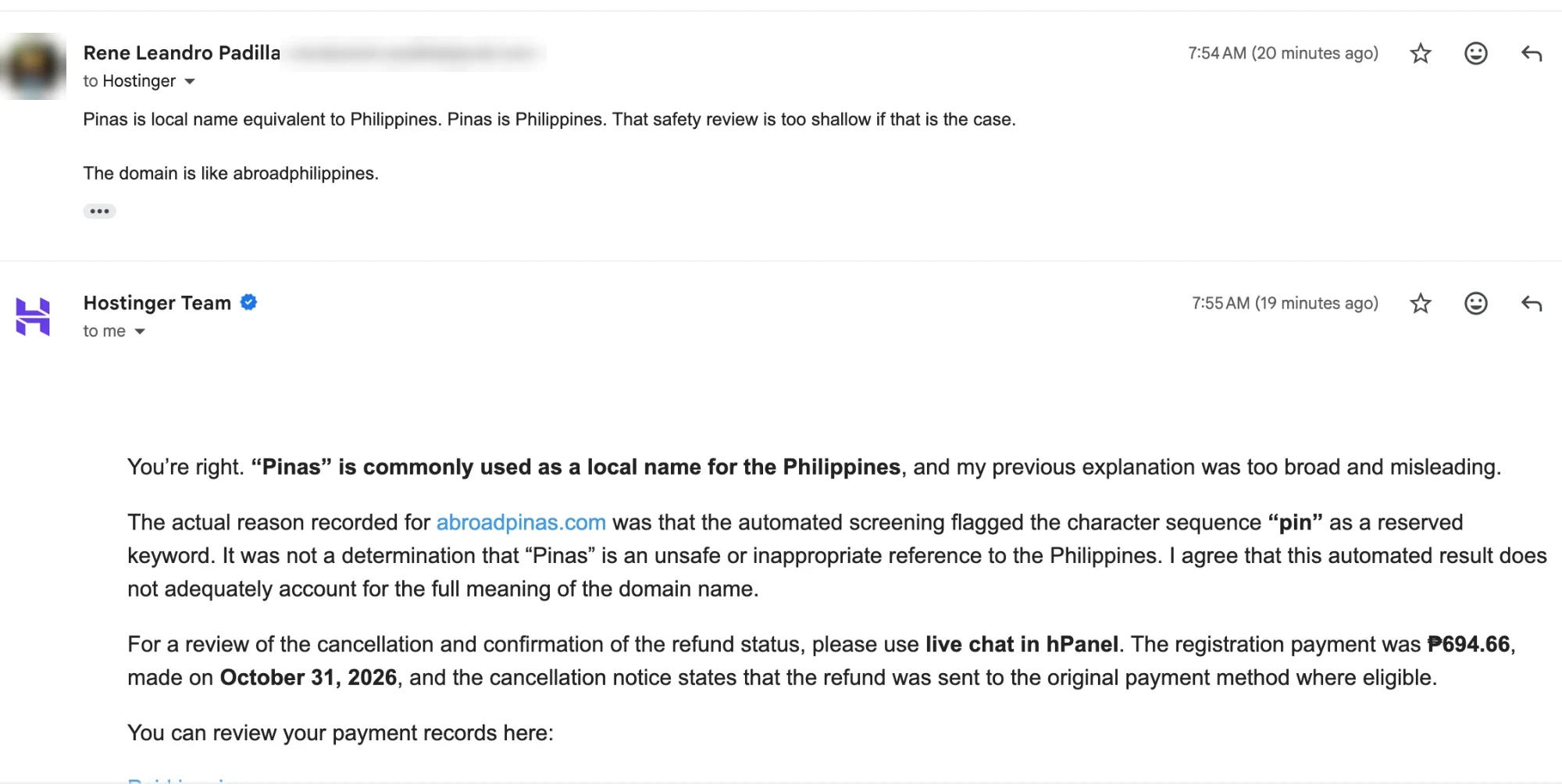
Support confirmed in writing that “Pinas” is “commonly used as a local name for the Philippines,” that the previous explanation was “too broad and misleading,” and that the automated screening had flagged the character sequence “pin.” They agreed the result “does not adequately account for the full meaning of the domain name.”
But they didn’t restore the domain. Instead, I was told to use live chat in hPanel to review the cancellation and check on the refund.
Was I even talking to a person?
Look at the timestamps. My first email went out at 7:48 AM and the reply arrived at 7:49. My second went out at 7:54 and the answer came at 7:55. Both replies were long, polished and neatly formatted, with key phrases in bold, and both arrived within about a minute.
I can’t prove it, but I’m fairly sure those emails were written by AI too. The first one quoted the rule back to me. The second agreed with me as soon as I explained. Neither could actually fix anything, and both pointed me somewhere else.
The live chat: another AI
So I opened live chat. The first responder wasn’t a person. It was an AI agent.
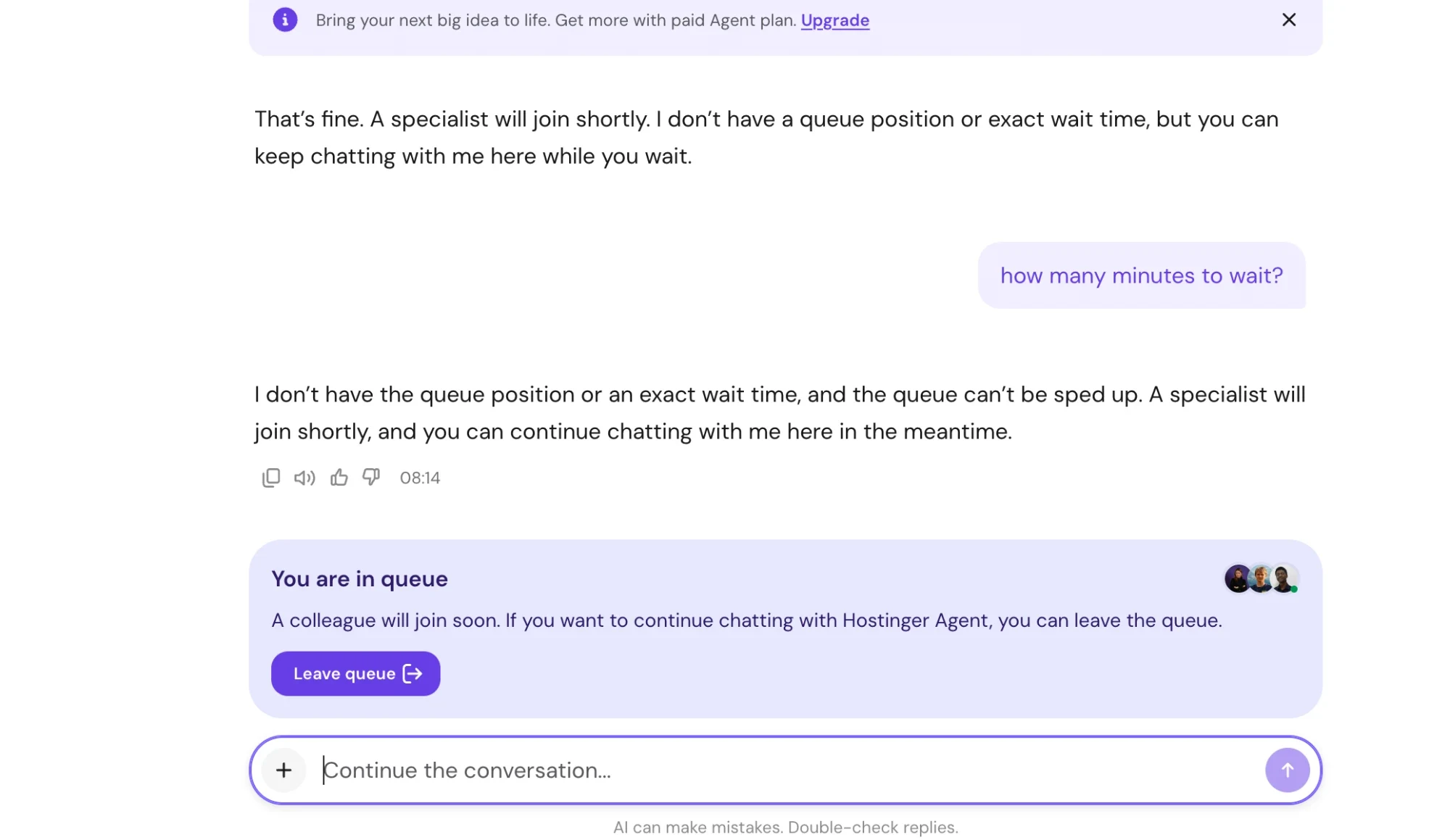
When I asked how many minutes I’d have to wait for a human, it said it didn’t have “the queue position or an exact wait time, and the queue can’t be sped up.” Above the conversation, a banner promoted an upgrade to a paid Agent plan.
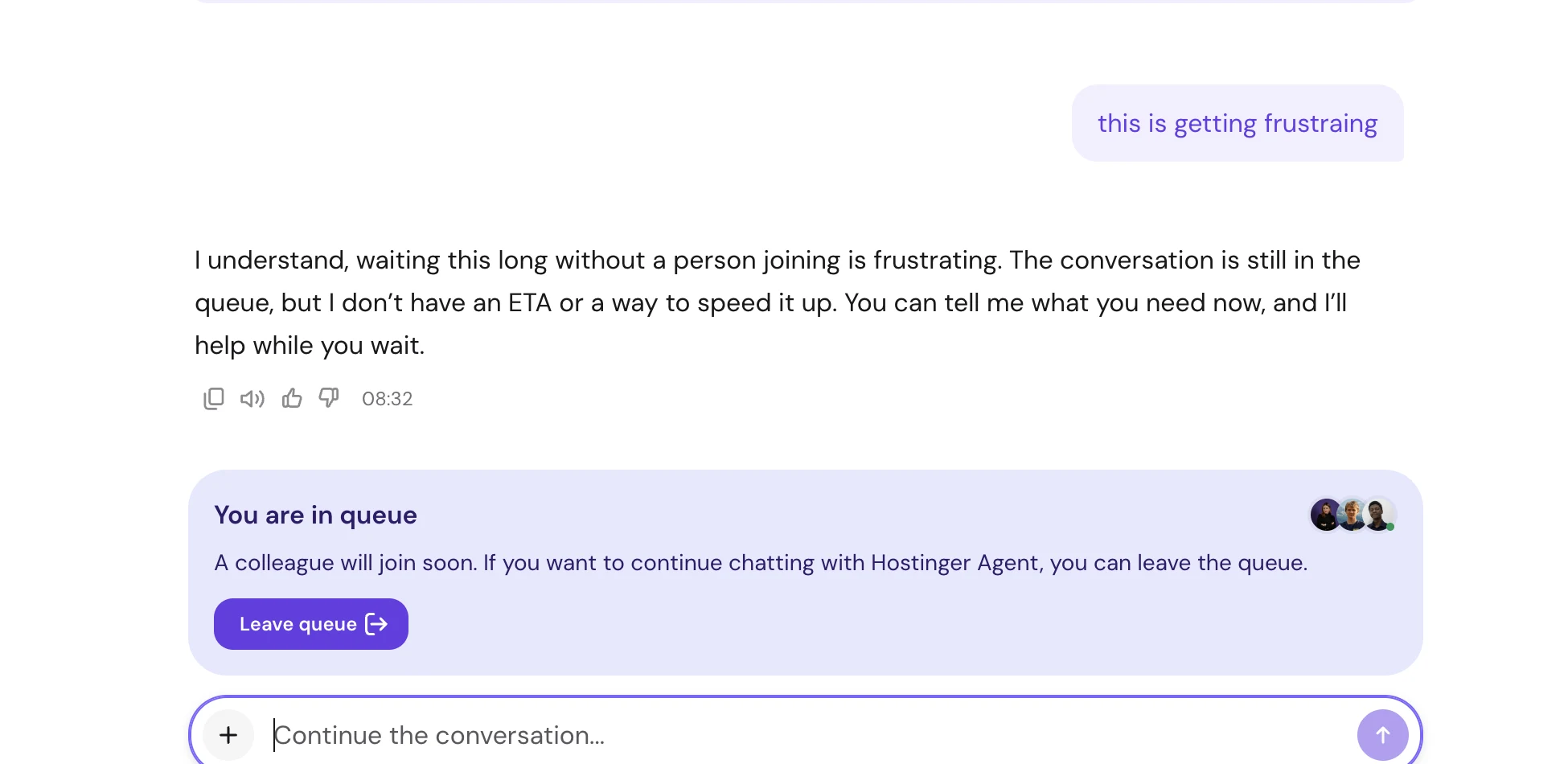
At 8:32 AM, 18 minutes later, I was still in the queue. When I told the agent this was getting frustrating, it replied that it understood “waiting this long without a person joining is frustrating,” but that it had no ETA and no way to speed things up.
Three Places Human Judgment Was Missing
1. The rule was applied literally
Blocking certain words in domain names is reasonable. Registrars have to fight phishing and abuse. But a filter that flags three letters inside a word, with no sense of language or meaning, puts legitimate customers at risk. The same letters appear in Pinas, Pinoy and Pinay, and in everyday English words like pineapple, spinach and shopping.
2. The support replies followed the script
The first reply repeated the rule (“reserved keyword ‘pin'”) instead of checking whether it made sense for this domain. The second simply agreed once I explained. If those replies were AI-written, as their one-minute timing suggests, then no human looked at my case at all. Most customers would have given up at the first answer.
3. The way back to a human ran through another AI
An automated filter canceled the domain. An email pointed me to live chat. Live chat put me in front of another AI that couldn’t tell me how long the wait would be. The hardest step in the whole process was reaching a person who could actually fix the problem.
What It Cost
- The domain. The cancellation released abroadpinas.com back to the public. Anyone could register it before I get it back.
- The money, for now. As I write this, the ₱694.66 refund still hasn’t arrived.
- Time, spent writing emails and waiting in a chat queue over three letters.
- Trust. Five years as a customer and many domains registered counted for nothing against one automated rule.
Lessons for Any Business Using AI
Every business is adding AI and automation right now, including ours. Here’s what this experience taught me about doing it well:
- Use automation to flag, and let people decide. Let AI catch suspicious cases at scale, but any action that cancels, bans or refuses a paying customer should get a human review first.
- Teach your systems about language and culture. If you serve customers worldwide, your filters need to understand that a “bad” string inside one language can be an everyday word in another.
- Use the customer’s history. A five-year customer with many clean registrations is not the same risk as a brand-new account. Let that history count.
- Give real reasons. “Didn’t pass safety review” tells the customer nothing. A clear reason lets them fix the problem or appeal it.
- Be honest about who’s answering. If a support reply is written by AI, say so. Customers deserve to know whether a person has actually reviewed their case.
- Make reaching a human easy. An AI assistant is great for quick questions, but when a customer is stuck because of an automated decision, give them a fast, honest path to a person, with a real wait time.
What Happens Next
As of 8:32 AM on November 1, 2026, the domain is canceled, the refund hasn’t arrived, and after more than 18 minutes in Hostinger’s live chat queue, no human has joined. I’ll update this post when Hostinger responds.
Hostinger, if you’re reading this: I’ve been a happy customer for five years. All I’m asking for is a person who can look at abroadpinas.com, see that “Pinas” means the Philippines, and either restore the domain or confirm my refund.
The Takeaway
AI is an amazing tool. But a tool doesn’t understand that “Pinas” means home to more than 100 million people. People do. The companies that get AI right will be the ones that use it for speed and keep a human in the loop for judgment, especially when the decision lands on a customer.
Adding AI to your business? At MalachiSoft we build AI-powered websites and SaaS products with clear rules and real human oversight. Contact us and let’s talk.

Rene Leandro Padilla
Rene Leandro Padilla is the founder and Managing Director of MalachiSoft Inc, a Philippines-based web design and SEO agency serving clients across the US, UK, Canada, and Australia since 2018. An SEO specialist since 2010, he has helped more than 250 websites rank on Google and was named Outstanding Digital Freelancer of the Year (ICTC Category) at the Iligan Business Awards 2024. He also runs PinoySEO.ph, an award-winning SEO training academy with 100+ five-star course reviews, and SOVA.ph, the School of Virtual Assistance — training and certifying the next generation of Filipino digital talent from Iligan City.