Shopify SEO Case Study: How an Australian Beauty Store Replaced Paid Ads with SEO (+47% Organic Revenue)

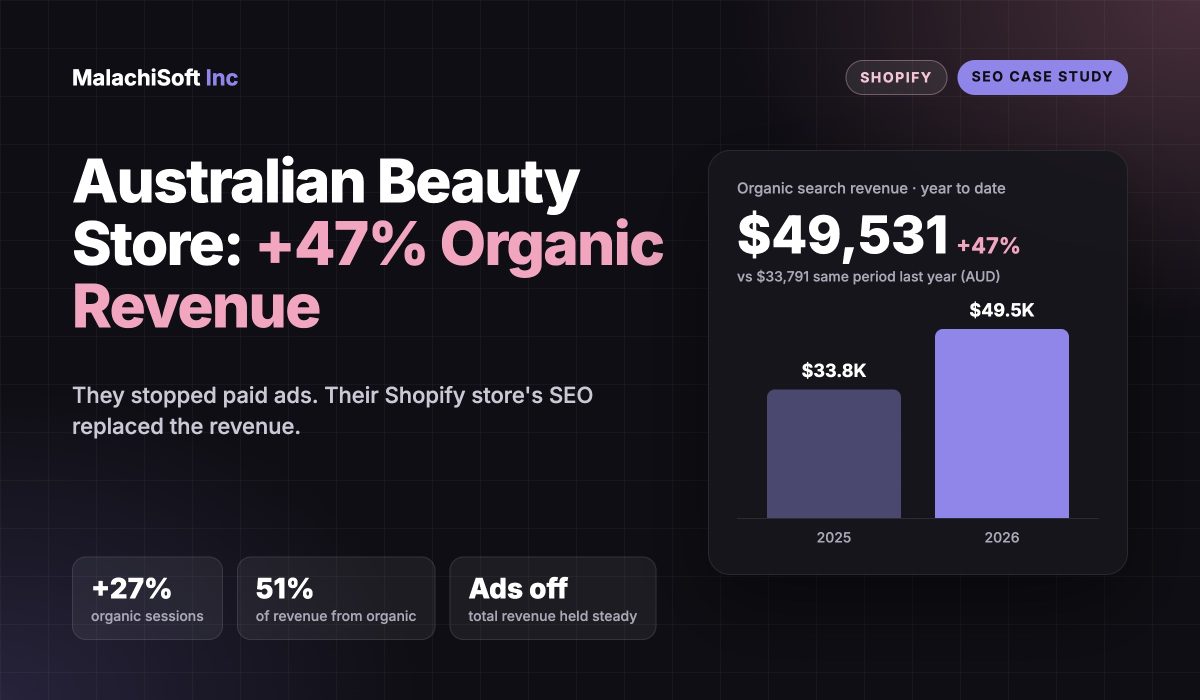
A MalachiSoft Shopify SEO case study: we built an Australian online beauty store on Shopify and optimized it for search. This year the store stopped paid advertising, and organic search more than made up for it. Year to date, organic revenue is up 47% and organic search now brings in over half of all sales.
Every online store owner knows the paid ads trap. Ads bring in sales, but the moment you stop paying, the traffic stops too. Organic search works differently. Once your store ranks for the products your customers are searching for, those visits keep coming without a cost per click.
This is the story of an Australian online beauty retailer that stopped its paid ads this year and didn’t lose revenue. We’re keeping the store anonymous, but every number below comes straight from its Google Analytics 4 account, comparing January 1 – October 27, 2026 with the same period in 2025.
The Client
The client is an independent online beauty store based in Australia, selling beauty products to customers nationwide. Like most beauty retailers, it competes against big marketplaces, department stores and the brands’ own websites for the same customers.
The Challenge
- Revenue that depended on ad spend. In 2025, paid ads brought in $16,867 in sales between January and October. Stopping them meant replacing that revenue some other way.
- A crowded market. Beauty is one of the most competitive e-commerce categories in Australia, and shoppers can buy the same products from many places.
- Product-heavy catalogs are hard to rank. Hundreds of product and collection pages with thin or duplicate manufacturer descriptions give Google little reason to rank one store over another.
Our Approach: A Shopify Store Built for Search
We handled both the Shopify build and the SEO, which meant search was part of the plan from the first page instead of something bolted on after launch.
1. A fast, mobile-first Shopify store
Many beauty shoppers browse on their phones, so we built the store mobile-first, with clean navigation, fast-loading product images and a simple checkout flow. A store that’s quick and easy to use keeps search visitors around long enough to buy.
2. Collections that match how people search
We organized collections around the way customers actually search, by product type, concern and brand, so each collection page can rank for its own group of keywords. Clear collection structure also gives Google a clean path to crawl every product.
3. On-page SEO for products and collections
We optimized titles, meta descriptions, headings and product copy around real search terms, added descriptive image alt text and linked related products and collections together. The goal was simple: give every important page a clear reason to rank.
4. Technical SEO on Shopify
Shopify handles a lot of SEO basics, but not all of them. We made sure the right pages were indexable, that product structured data was in place so listings can show rich results, and that the sitemap, canonical URLs and Google Search Console setup were all working properly.
The Results
Organic revenue grew 47%
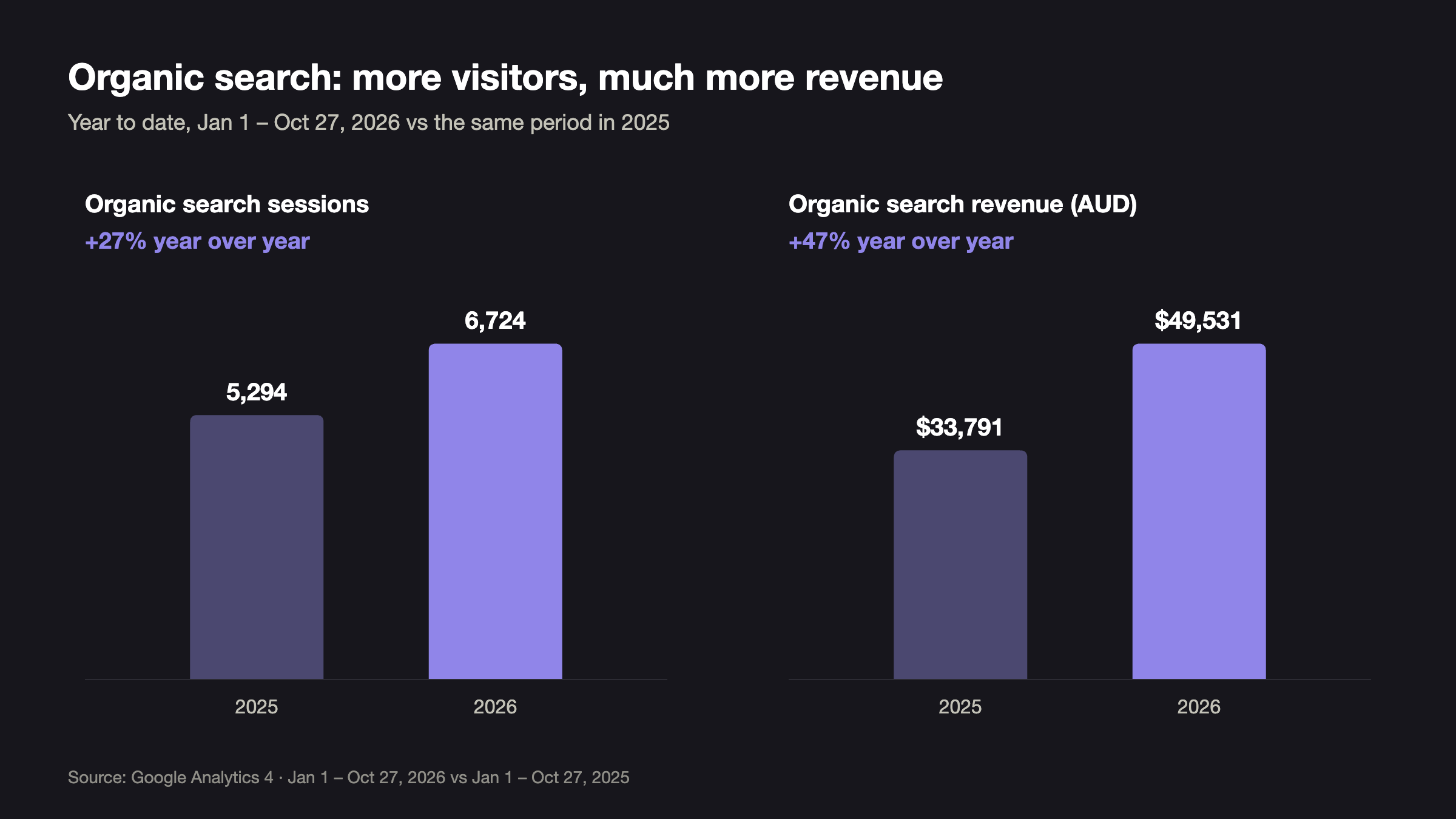
Organic search sessions grew from 5,294 to 6,724 (+27%). Revenue from those visitors grew much faster, from $33,791 to $49,531 AUD (+47%). That’s $15,740 in extra revenue from customers who found the store on search engines, without paying for a single click.
| Organic search (Jan 1 – Oct 27) | 2025 | 2026 | Change |
|---|---|---|---|
| Sessions | 5,294 | 6,724 | +27% |
| Engaged sessions | 3,366 | 4,190 | +24% |
| Avg. engagement time per session | 61 seconds | 68 seconds | +12% |
| Key events (conversions) | 235 | 300 | +28% |
| Revenue (AUD) | $33,791 | $49,531 | +47% |
| Revenue per session | $6.38 | $7.37 | +15% |
| Revenue per key event | $144 | $165 | +15% |
Better visitors, not just more of them
Revenue grew faster than traffic, which means search is bringing in the right shoppers. Each organic visit is now worth $7.37, up from $6.38. Each conversion is worth $165, up from $144. The conversion rate held steady at about 4.5% even as visitor numbers grew, so the new traffic converts just as well as the old.
SEO replaced the revenue from paid ads
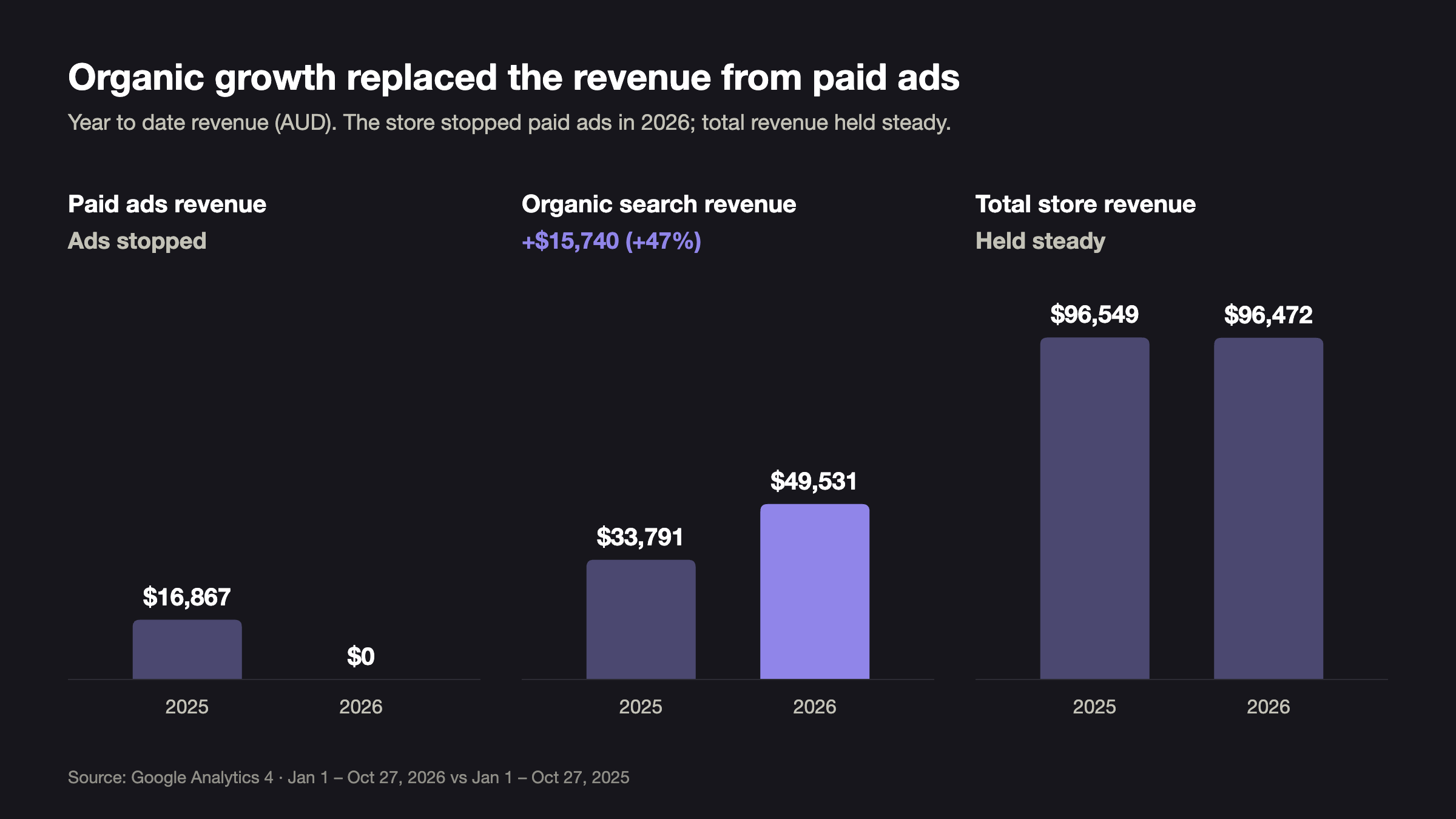
This is the result that matters most to the business. In 2025, paid ads brought in $16,867 in sales over these ten months. In 2026 the store stopped paid advertising completely.
Normally that would mean a drop in sales. Instead, organic search grew by $15,740, covering almost all of the revenue the ads used to bring in. Total store revenue held steady at $96,472, compared with $96,549 last year, a difference of less than 0.1%.
In other words, the store now earns the same revenue without an ad budget. Every dollar it used to spend on ads is a dollar it keeps.
Organic search is now the #1 revenue channel
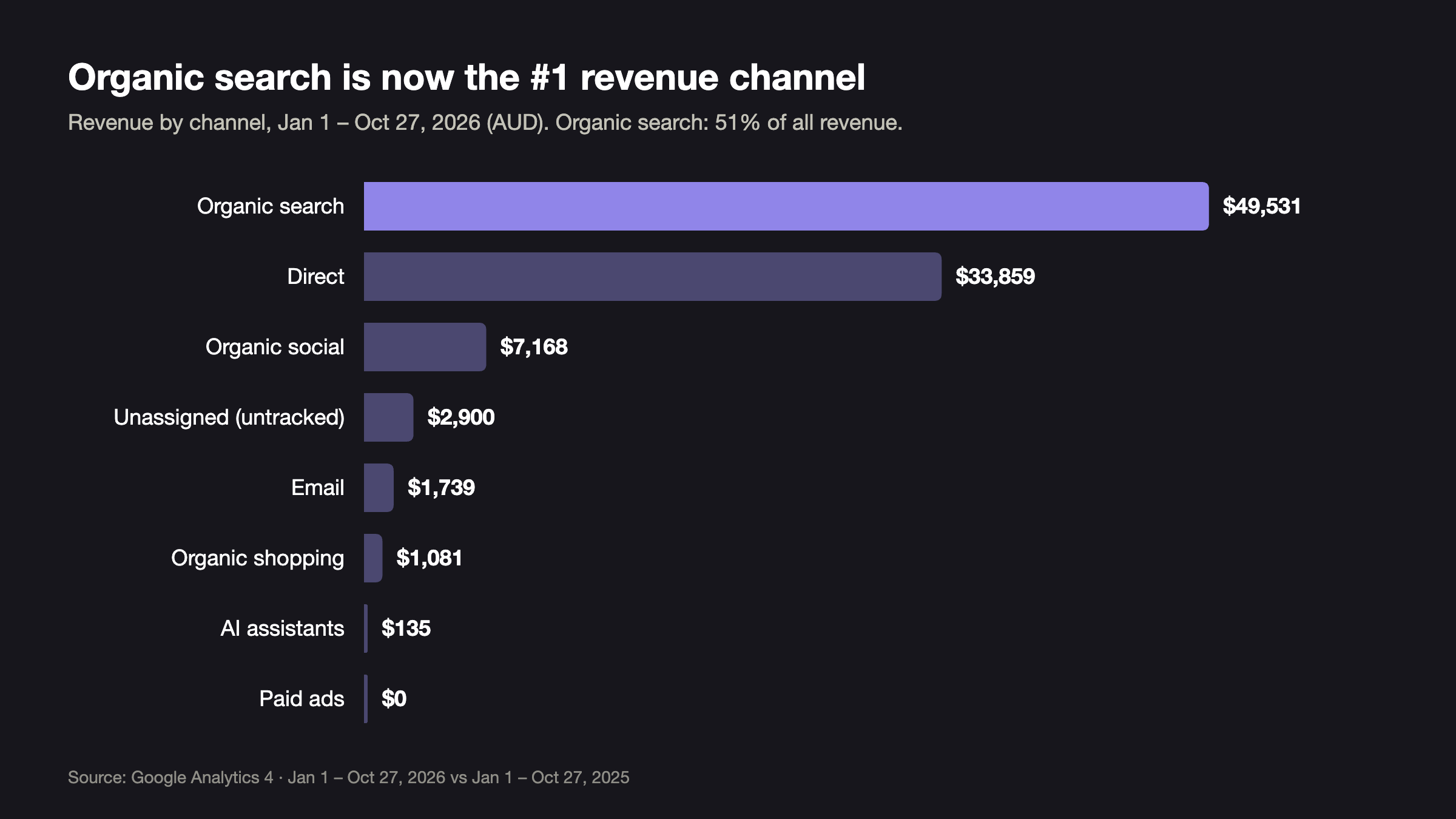
Last year, direct traffic was the store’s biggest revenue source. This year it’s organic search, by a wide margin. Organic search now brings in 51% of all store revenue (up from 35%) and 55% of all key events (up from 36%).
AI assistants are starting to send shoppers
One new source appeared this year: 114 sessions from AI assistants such as ChatGPT, including the first sales from that channel. A year ago there were none. It’s small for now, but the same clear product pages and structured data that help with Google also make a store easier for AI tools to recommend.
What’s Next
With organic search now carrying more than half of the business, the next phase is about building on that lead:
- Conversion optimization on the collection and product pages that receive the most organic traffic.
- Expanding content around beauty concerns and how-to searches that lead naturally to products.
- Cleaner analytics, so every sale is attributed to the right channel and we can measure SEO’s impact even more precisely.
The Takeaway
Paid ads rent you customers. SEO helps you own the channel. For this Australian beauty store, a well-built Shopify store and consistent SEO grew organic revenue 47%, made organic search more than half of the business, and allowed the store to switch off paid ads without losing revenue.
Spending too much on ads to keep your Shopify store’s sales going? MalachiSoft builds and optimizes Shopify stores for search, for clients in Australia, the US, the UK and beyond. Contact us and let’s talk.
Related Case Studies
- Vibe-Coded WordPress SEO: How PickleMap.ph Grew Google Clicks 9x Without Backlinks: technical and on-page SEO alone took a brand-new directory from 17 to 160 weekly Google clicks.
- Wix to WordPress SEO: How a Denton Podiatry Practice Started Ranking for “Podiatrist Denton”: a platform migration plus local SEO for a medical practice in Texas.
- Texas SEO: How We Helped HILLMED Get Found on Google and ChatGPT: brand cleanup, content and AI visibility for a wellness practice in Plano.
- ChatGPT Ads: 22 Leads at $52 Each in 6 Weeks for a Wellness Practice: when paid ads do make sense, a look at one of the newest ad channels.

Rene Leandro Padilla
Rene Leandro Padilla is the founder and Managing Director of MalachiSoft Inc, a Philippines-based web design and SEO agency serving clients across the US, UK, Canada, and Australia since 2018. An SEO specialist since 2010, he has helped more than 250 websites rank on Google and was named Outstanding Digital Freelancer of the Year (ICTC Category) at the Iligan Business Awards 2024. He also runs PinoySEO.ph, an award-winning SEO training academy with 100+ five-star course reviews, and SOVA.ph, the School of Virtual Assistance — training and certifying the next generation of Filipino digital talent from Iligan City.