How We Built 9 SaaS Products in the Philippines — and What We Learned About Building Software Businesses Here
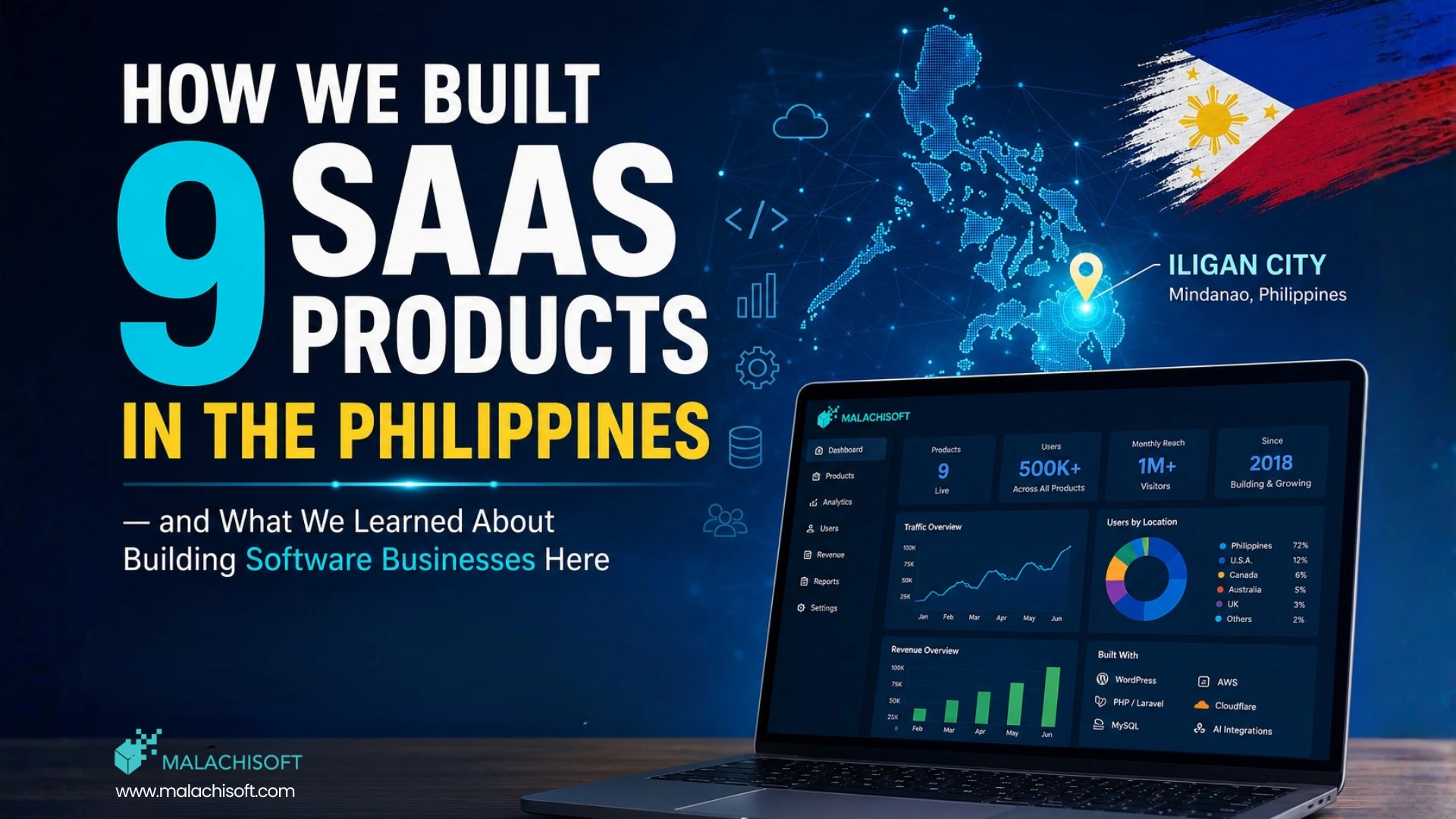
Or: why building SaaS from Iligan turned out to be more advantage than obstacle.
The startup playbook says you build SaaS in San Francisco, raise venture capital, and pray to the gods of CAC payback.
We built ours from Iligan City. No venture capital. No co-founders flown in from Silicon Valley. Just nine products shipped under one roof — and a slow accumulation of lessons about what actually works when you’re trying to make software in the Philippines.
If you’re a Filipino founder considering SaaS — or an international founder considering building your SaaS team here — this is what we wish someone had told us before we started.
The Nine Products
Before we extract lessons, here’s what we built. All nine are live, all nine are owned and operated by MalachiSoft Inc, and each one solves a real problem we (or someone we knew) actually had:
Calculators.ph — A free hub of 130+ Philippine calculators (SSS, BIR, Pag-IBIG, PhilHealth, 13th month, Meralco, loans). Always updated with current rates. Built because every other “PH calculator” site we tried gave wrong numbers.
BiblicalLifeLessons.com — Daily 3-minute devotionals rooted in Scripture, paired with Faith Friend, our AI companion trained on the site’s library. Built for everyday believers tired of long-form theology and looking for practical faith.
ExamsPinas.com — The online guide for Philippine licensure and board examinations: CPA, Nursing, Criminology, Architecture, Civil Service, UPCAT and more. Plus a curated job board for Filipino educators.
PromoteIligan.com — Iligan City’s local business directory and news hub. 491+ businesses across 213 categories, 50,000+ monthly readers, 5 years strong.
PickleMap.ph — The Philippines’ #1 pickleball court directory. 45+ courts across 25 cities, with bookings, reviews, and owner dashboards. Built when we realized there was no central way to find a court to play at.
DigitalKids.ph — Free, game-based digital skills for Filipino kids aged 8–12. 25 learning worlds and 40+ mini-games teaching coding, web design, AI, online safety, freelancing, money skills. No login, no ads, no in-app purchases, free forever.
GraceMatch.ph — Faith-verified dating for Christian Filipinas seeking godly husbands worldwide. Built to fix what other dating sites won’t: rampant scams, fake profiles, and no values alignment.
SOVATalents.com — A vetted marketplace for hiring Filipino digital talent — graduates of our own PinoySEO and SOVA academies. Certified specialists in SEO, WordPress, virtual assistance, GoHighLevel, AI automation.
SOVAPraxis.com — The AI evaluation engine that scores and gives feedback on every student task at our academies. Feedback in seconds instead of weekends, every result educator-reviewed before release. Without Praxis, there’d be no certified graduates on SOVATalents.
Nine products. Three distinct audiences (Filipino consumers, international clients hiring Filipino talent, and our own internal team). One owner.
Here’s what they taught us.
Lesson 1: Start with a problem you can’t stop thinking about
The first calculator on Calculators.ph existed because we kept computing 13th month pay wrong for our own team. The first listing on PromoteIligan existed because our restaurant client had nowhere local to be discovered. BiblicalLifeLessons started because the founder was journaling devotionals anyway.
If you’re solving a problem you have to invent a reason to care about, you’ll burn out before product-market fit. The Philippine SaaS landscape doesn’t have a “long tail of patient capital” the way the US does. You need to genuinely want to keep building, even on weeks 47, 113, and 264.
So our advice: pick the problem first. The market size, the monetization, the GTM — all of it gets easier when the founder still wakes up at 6am wanting to make the product better.
Lesson 2: Build for free, monetize the boring layer
Eight of our nine products start free. Calculators.ph is 100% free forever. DigitalKids.ph is 100% free forever. ExamsPinas is free to read. PromoteIligan is free to browse. GraceMatch is free to browse.
Where money comes in is the boring infrastructure layer — the part most founders feel guilty about charging for, even though it’s the part with the clearest value exchange.
- PromoteIligan → free for readers;
- PickleMap.ph → free for players; ₱799/month for court owners who want bookings + analytics
- GraceMatch → free for Filipinas; $29.99 (Grace) and $59.99 (Beloved) for foreign men who want messaging + matchmaking
- SOVATalents → free to browse and contact; a one-time placement fee when you actually hire
This is the two-sided market playbook: the side that creates the content, listings, or profiles gets it free. The side that benefits from access pays. Filipinos generally pay less; international users generally pay more. Both sides get value.
If you’re building a Philippine SaaS, ask: who’s getting value from the product, and who’s creating value by being on it? Charge the first. Subsidize the second.
Lesson 3: AI is your unfair advantage — if you use it in evaluation, not just chat
SOVA Praxis is our most quietly powerful product, because it doesn’t look like a SaaS product at all. It looks like a grading tool.
But under the hood: every essay, skill task, training submission, and portfolio piece goes through an AI evaluator that writes specific feedback in seconds. Educators then approve, override, and release. Grading time per student dropped from ~2 hours of weekend work to ~5 minutes of weekday review.
That’s the model for AI inside any SaaS business right now: AI does the first pass, humans do the final call. Not “AI replaces the human” — that’s a hype-cycle pitch. AI compresses the cognitive load on a routine task so the human can spend their judgment on the exceptions.
If you’re building a Philippine SaaS and not asking “where can AI do the first 80% so my human team only handles the last 20%,” you’re leaving five years of competitive advantage on the table.
Lesson 4: Hire from inside your own pipeline
The most under-discussed part of building SaaS in the Philippines is talent. Senior product engineers are absurdly expensive globally. Junior engineers are everywhere but variable quality. Where do you find the trained, vetted middle?
We built it ourselves.
PinoySEO trains SEO specialists. SOVA trains virtual assistants and WordPress designers. Every graduate completes hands-on tasks evaluated through SOVA Praxis. The best of them get listed on SOVATalents. We hire from the same pipeline ourselves — every deliverable from our agency is built or supported by a graduate of our own academies.
This wasn’t strategic at first. It became strategic when we realized: the agencies and SaaS companies that grow sustainably in the Philippines are the ones that own their talent pipeline. Don’t outsource your hiring to chance.
Lesson 5: Localize the actual data, not just the language
The biggest mistake we see in Philippine SaaS attempts: they assume “Filipino market” just means “translate to Tagalog/Cebuano.”
The actual moat is data localization: knowing the real 2026 SSS contribution table; knowing which PRC board exams happen which months; knowing that Iligan has 213 business categories worth indexing; knowing where pickleball courts actually opened last month; knowing which DTI/BIR registration paths a freelancer should take.
International SaaS players cannot beat Filipino SaaS on local data. They won’t update SSS rates the day they change. They won’t know which barangay just opened a new resort. They won’t catch that the BIR released TRAIN-law adjustments mid-year.
The advantage of building Philippine SaaS in the Philippines is being able to ship local data updates faster than any global competitor.
When you scope your product, ask: what’s the unique local data layer that compounds in our favor over time?
Lesson 6: Distribution before features
Calculators.ph ranks for “SSS contribution calculator 2026,” “13th month pay calculator Philippines,” “BIR withholding tax calculator.” That distribution channel — Google search for the actual problems Filipinos type — is where 90% of our traffic comes from.
We’ve shipped exactly one calculator that wasn’t in the original keyword research. Everything else was reverse-engineered from search demand. The product is the SEO. The SEO is the product.
PromoteIligan ranks for “[restaurant name] Iligan,” “Iligan resorts,” “Iligan job hiring.” Same model. ExamsPinas ranks for “CPALE review,” “PNLE 2026,” “PRC board exam schedule.” Same model.
If you’re building consumer SaaS in the Philippines, the order is:
- Pick a search term you can rank for
- Build the product that answers it
- Optimize the conversion
Not the other way around. Most Philippine SaaS founders spend year one building features and year two desperately looking for users. We do it the other way.
(B2B SaaS is different — distribution there is outbound + partnerships. But that’s a different essay.)
Lesson 7: Filipino corporate registration is a moat
In 2026 MalachiSoft became a SEC-registered Philippine corporation. The DTI/BIR registration we’d had since 2018 was fine for a freelance team. The corporation is what unlocked partnerships, contracts with international clients on retainer, and the ability to be the formal owner of all nine SaaS properties.
If you’re past the side-project stage and starting to ship real SaaS in the PH, get registered properly. SEC-registered corporation, full BIR compliance, PEZA if applicable. It opens doors that DTI alone won’t:
- Foreign customers checking due diligence will Google your registration status
- School partnerships will require it
- Future investors will look at your cap table
- Banks and payment processors take you seriously
The cost of incorporation is laughably small compared to the doors it opens.
How we can help
We didn’t write this to flex. We wrote it because we keep getting asked: “Can you help us build something like Calculators.ph, but for [industry]?” and “How do we structure a SaaS business in the Philippines?”
The answer is yes — that’s what MalachiSoft Inc’s SaaS Business Creation & Support service is. End-to-end product development: concept, design, build, launch, scale. We bring everything we learned from the nine products above to bear on your idea.
What’s included:
- Product strategy — picking the right problem, the right monetization layer, the right local data moat
- Design & build — full WordPress and headless development, hosted on our own infrastructure
- AI integration — where AI can compress your team’s cognitive load (like Praxis does for grading)
- Talent staffing — hiring vetted graduates from our SOVATalents marketplace to operate the product
- SEO & distribution — the keyword research → product → conversion playbook in action
- PH corporate setup — DTI/BIR/SEC registration, compliance, structure
If you’re a Filipino founder with an idea, or an international founder looking to build a SaaS using a Filipino team and product partner — talk to us.
MalachiSoft Inc is a SEC-registered Philippine corporation operating since 2018. We design and build SaaS, websites, and digital infrastructure for clients across the US, UK, Canada, Australia and the Philippines. From our studio in Iligan City, we run two training academies (PinoySEO and SOVA), one talent marketplace (SOVATalents), one AI evaluation engine (SOVAPraxis), and nine in-house SaaS products. We’d love to help build yours.

Katherine Padilla
Katherine Padilla is an entrepreneur, virtual assistant coach, and co-founder of SOVA (School of Virtual Assistance), a Cebu-based training institution dedicated to helping aspiring virtual assistants develop the skills needed to build successful online careers. Together with her husband, Rene Leandro Padilla, she manages several business ventures, including Pipie Co, a cake, bread, and pastry shop in Iligan City, and supports various digital education initiatives through PinoySEO and MalachiSoft.com. Passionate about empowering individuals through education, Katherine actively mentors students, aspiring freelancers, and virtual assistants. Through her work in training, entrepreneurship, and community development, she continues to inspire Filipinos to pursue opportunities in the digital economy while supporting local businesses and innovation.